· Updated:
The reasons why Zaragoza locals feel pride in their millenary city
Zaragoza locals love their city for its perfect size, rich history, incredible tapas scene, the Ebro river, and a quality of life that balances urban energy with genuine warmth — a combination that makes the Aragonese capital one of Spain's most underrated and most beloved cities by those who call it home. Known affectionately as ZGZ (the airport code used as a shorthand by locals), Zaragoza is a city that inspires deep, genuine attachment.
Walk through Zaragoza's historic centre and you are tracing the footsteps of Romans, Muslims, Jews, and Christians across two millennia. The city was founded as Caesaraugusta by the Emperor Augustus around 14 BC, and the Roman legacy is still visible in the theatre, the forum, the river port, and the public baths — all within a few minutes' walk of each other. Under Moorish rule in the 11th century, Zaragoza (then Saraqusta) became one of the great cultural centres of Al-Andalus. The magnificent Aljafería Palace, with its intricate arches and peaceful gardens, remains the finest surviving example of Taifa-period Islamic architecture in Spain.
But locals are not precious about their history. The Roman theatre hosts open-air concerts in summer. The Aljafería is the seat of the Aragonese Parliament. History in Zaragoza is not a museum piece — it is a living, breathing part of daily life. That ease with the past is one of the things Zaragoza residents cite most often when asked why they love their city.
With about 700,000 inhabitants in the urban area, Zaragoza occupies a sweet spot that few Spanish cities manage to hit. It is large enough to support a world-class opera house (the Teatro Principal), an internationally respected film festival, a Michelin-starred restaurant scene, and a major university. Yet it is compact enough that you can walk from the Aljafería to the Basilica of the Pillar in 25 minutes, bumping into friends and neighbours along the way.
Traffic is manageable, public transport is efficient, and the bike-sharing system (BiZi) makes it easy to get around without a car. Housing prices, while rising, remain significantly more affordable than in Madrid, Barcelona, or Valencia. For young families and professionals, this combination of opportunity and affordability is increasingly rare and increasingly valued.
Ask ten Zaragoza locals what they love most about their city, and at least eight will mention the food. The city's position at the crossroads of Aragón, Navarre, La Rioja, and Catalonia has created a cuisine that draws from the best of each. The produce is exceptional: Ternasco de Aragón lamb, borage and cardoons from the Ebro orchards, olive oil from the Bajo Aragón, cured ham from Teruel, and saffron from Jiloca.
But it is the tapas culture that captures hearts. The labyrinth of narrow streets known as El Tubo is home to dozens of bars, each with its speciality. One bar serves only migas (fried breadcrumbs with chorizo and egg), another only wild mushrooms in season, another only seafood. Locals spend their weekends moving from bar to bar, enjoying a caña (small beer) and a tapa at each stop. This is not a tourist performance — it is how people actually socialise. The maraschino cherries that garnish the city's Dry Martinis and the saffron milk caps that appear in autumn stews are emblematic of a food culture that takes its ingredients seriously but never loses its sense of pleasure.
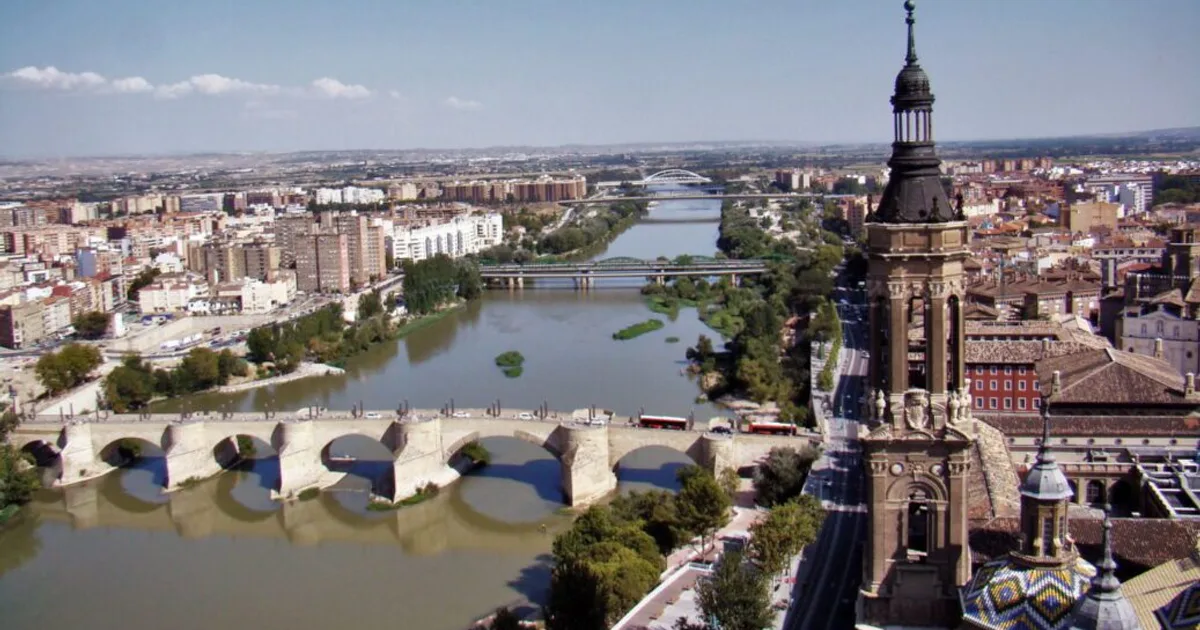
Spain's most powerful river flows through the centre of Zaragoza, and the city has embraced it in ways that make other riverfront cities envious. Both banks have been transformed into a continuous ribbon of parks, cycle paths, and recreational spaces stretching for kilometres. On any given weekend, thousands of ZGZ locals are walking, running, cycling, or simply sitting on a bench watching the water and the birds.
The river is also the backdrop for the city's most iconic moments: the sun setting behind the Basilica of the Pillar, reflected in the Ebro's slow current; the Stone Bridge, its 15 arches carrying pedestrians across the water as they have since the 15th century; the modern Bridge Pavilion, Zaha Hadid's diamond-shaped masterpiece from Expo 2008. The Ebro gives Zaragoza its sense of space and serenity — a constant reminder that nature is never far away.
Zaragoza knows how to celebrate. The Fiestas del Pilar in October are among Spain's greatest urban festivals, with a week of concerts, processions, bullfights, and the extraordinary Ofrenda de Flores (Flower Offering), in which the Plaza del Pilar is transformed into a vast carpet of blooms. Throughout the year, neighbourhood festivals, food markets, and cultural events keep the city's calendar full.
Beyond the big events, locals prize the smaller rhythms of community life: the Sunday morning stroll through the Mercado Central, the summer terraces along the Ebro, the impromptu tertulias (conversations) that spill out of bars and cafés. Zaragoza is a city of strong social bonds — a place where people know their neighbours, support local businesses, and feel a genuine stake in their community's well-being.
Expo 2008 was a turning point for Zaragoza. The water-themed world exposition brought investment, infrastructure, and international attention that reshaped the city's self-image. The Expo site on the river's meander is now a technology park, home to innovative companies and research centres. Zaragoza has become a hub for logistics, renewable energy, and food technology, attracting talent from across Spain and Europe.
This forward-looking attitude coexists with deep-rooted tradition in a way that feels natural rather than forced. Locals are proud that their city hosted a world expo, but they are equally proud that their grandmother's recipe for migas is still served in the same bar where she ate it as a child. That balance — between progress and preservation, between the global and the local — is perhaps the deepest reason why Zaragoza locals love their city.
To experience Zaragoza like a local, stay in the historic centre. Maestro Luna is a beautifully appointed apartment on a quiet street just minutes from El Tubo, the Basilica, and the Ebro riverfront. Las Armas offers a larger, modern space that is equally central. Both provide the comfort, privacy, and authentic neighbourhood feel that lets you live like a ZGZ local, even if only for a few days.
Zaragoza has around 700,000 inhabitants — large enough to offer all the cultural, gastronomic, and professional opportunities of a major city, but compact enough that you can cross the historic centre on foot in 30 minutes. Locals love that they can enjoy world-class museums, restaurants, and events without the traffic, crowds, and expense of Madrid or Barcelona.
Zaragoza sits at the crossroads of three of Spain's most important gastronomic regions. From Aragón it draws lamb, olive oil, mushrooms, and cured meats. From nearby Navarre and La Rioja come exceptional vegetables and wines. The city's tapas culture — centred on the historic El Tubo district — is among Spain's most vibrant, with bars specialising in everything from migas to seafood.
The Ebro is Zaragoza's defining geographical feature. Its banks have been transformed into linear parks with cycling paths, gardens, and outdoor cafés. The river is a constant presence in local life — a place to walk, run, cycle, or simply sit and watch the water flow beneath the city's historic bridges. The river park is the city's most democratic public space.
Zaragoza's history spans over 2,000 years of continuous urban life, from its foundation as the Roman colony of Caesaraugusta to its role as a centre of Islamic Taifa kingdoms, through the splendour of the Aragonese crown, the devastation of the Napoleonic sieges, and its modern rebirth as a forward-looking European city. Four Roman monuments, a Moorish palace, and two cathedrals stand within walking distance of each other.
Yes, Zaragoza is an excellent city for families. It has affordable housing compared to Spain's largest cities, an extensive network of public parks and playgrounds, good schools, and a safe, walkable urban environment. The city's festivals, especially the Fiestas del Pilar, offer family-friendly programming. The climate provides over 2,600 hours of sunshine per year, making outdoor activities possible almost year-round.
Make Zaragoza your base. Our boutique apartments are just minutes from all attractions.
Maestro Luna Apartment Las Armas Apartment