· Updated:
The splendour of Islamic taifa art in the heart of Zaragoza
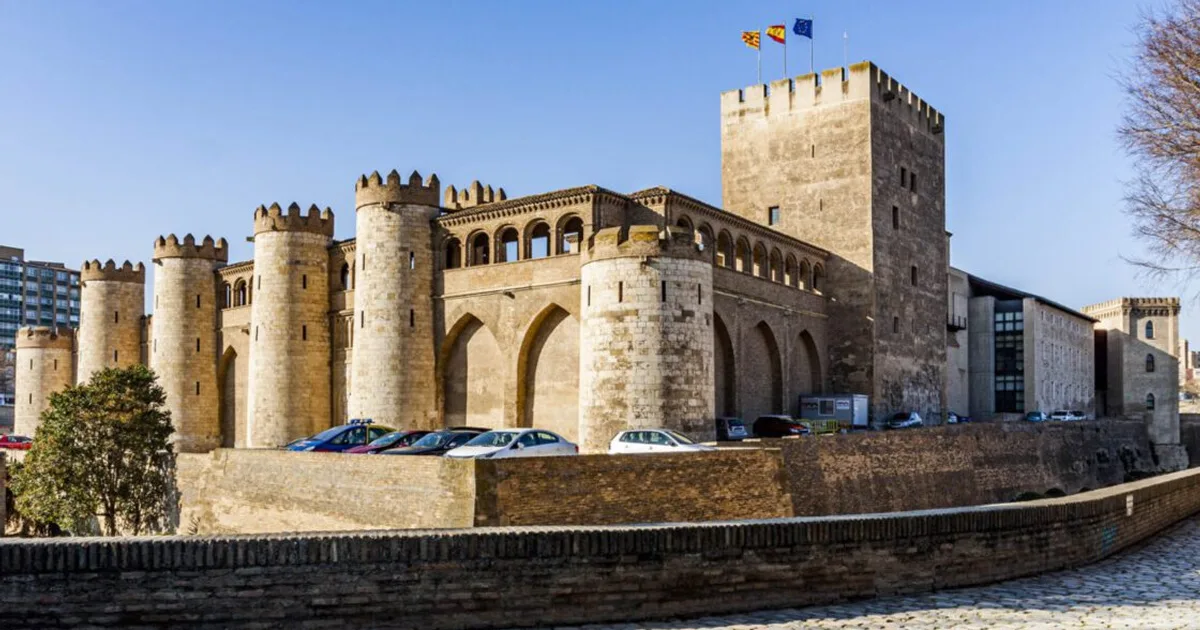
The Aljafería Palace is an 11th-century Islamic fortress-palace, the finest surviving example of Taifa-period architecture in Spain and the jewel of Mudejar art in the Aragonese capital. Built during the reign of Ahmad al-Muqtadir, king of the Taifa of Zaragoza, this magnificent complex stands as a testament to the sophisticated culture of Al-Andalus and the unique architectural fusion that defines Aragón. Today it serves as the seat of the Cortes de Aragón, the regional parliament, making it one of the few active government buildings in the world that began life as a medieval Islamic palace.
The palace's name derives from the Arabic "al-Jafería", meaning "the fortress of the Jafari", named after its founder Abu Jafar al-Muqtadir. Unlike the Alhambra, which was built over several centuries, the core of the Aljafería was constructed in a single concentrated period between 1065 and 1081, giving it an unusual architectural coherence. Its survival through nine centuries of political upheaval — from Islamic taifa to Christian kingdom, from the Spanish Inquisition to military barracks and finally to democratic parliament — is nothing short of miraculous.
The original Islamic palace centres around a rectangular courtyard with ornamental gardens and reflecting pools, following the classic Mediterranean model of the Roman villa adapted by Islamic architecture. The most spectacular surviving space is the Golden Hall (Salón Dorado), a throne room dominated by a central arch framed by intricate stucco arabesques. The intersecting horseshoe arches, adorned with plant motifs and calligraphic inscriptions in Kufic script, create a mesmerising visual rhythm that changes throughout the day as sunlight filters through the latticework.
Adjacent to the hall is the tiny oratory, a private prayer room measuring barely six square metres but encrusted with the most exquisite muqarnas (honeycomb vaulting) in the entire palace. The mihrab, oriented towards Mecca, is framed by a horseshoe arch carved from a single block of alabaster, so thin that it becomes translucent when the sun hits it at the right angle.
After the Christian conquest of Zaragoza in 1118, the Aljafería became the residence of the Kings of Aragón. Peter IV, known as "the Ceremonious", added a new palace wing in the 14th century that represents the pinnacle of Aragonese Mudejar art. The ceiling of the Throne Hall is a masterpiece of carpentry, with interlaced wooden beams painted in red, blue and gold that depict stars, dragons and heraldic motifs. The plasterwork, executed by Muslim artisans working under Christian patrons, combines Islamic geometric patterns with Gothic figurative elements — a fusion that UNESCO recognised when it declared the Mudejar Architecture of Aragón a World Heritage site.
The palace later served as the headquarters of the Spanish Inquisition in Aragón, then as a military barracks for centuries. Extensive restoration work in the 20th century uncovered and preserved the original Islamic and Mudejar layers, and since 1987 the building has been the official seat of the Aragonese Parliament. Visitors today can see the parliamentary chamber where modern legislators debate — a powerful symbol of the continuity of governance on this site across eleven centuries.
After visiting the Aljafería, take time to explore Zaragoza's other architectural treasures. La Seo de Zaragoza, the city's cathedral, offers another extraordinary journey through architectural styles from Romanesque to Baroque. For a contrast in scale and period, the Grand Park of Zaragoza provides a peaceful green escape where you can rest after your cultural explorations. And if you have time for a day trip, the ghost village of Belchite is a hauntingly beautiful contrast to the Aljafería's restored splendour.
To make the most of your visit to Zaragoza's monuments, choose accommodation in the historic centre. Our Maestro Luna apartment is a beautifully appointed one-bedroom space just a 15-minute walk from the Aljafería Palace, with direct access to the city's best restaurants and shops. For those travelling with family or friends, the Las Armas apartment offers two spacious bedrooms and a full kitchen, located on the peaceful banks of the Ebro river yet within easy walking distance of all major attractions. Both apartments are thoughtfully equipped for a comfortable stay, with free WiFi, air conditioning and premium bedding.
Address: Calle de los Diputados, s/n, 50003 Zaragoza
How to get there: 15 min walk from Plaza de España. Bus lines 21, 22, 24, 33, 34, 35, 36, 39, 40, 41, 42, 52, Ci1, Ci2.
Opening hours: Mon-Sat 10:00-14:00 & 16:00-19:00 (winter) / 20:00 (summer). Sun 10:00-14:00.
Admission: General 5€. Reduced 3€. Free on Sunday afternoons.
The Aljafería Palace is an 11th-century Islamic fortress-palace built by the Taifa kings of Zaragoza. It is one of the three great surviving examples of Islamic architecture in Spain alongside the Alhambra in Granada and the Great Mosque of Córdoba, and currently serves as the seat of the Aragonese Parliament.
The Aljafería is a 15-minute walk from Plaza de España, or a 5-minute bus ride on lines 21, 22, 24, 33, 34, 35, 36, 39, 40, 41, 42, 52, Ci1 or Ci2. The nearest tram stop is Plaza de España, from where it is a pleasant walk through the historic quarter.
Yes, the Aljafería Palace was declared a UNESCO World Heritage site in 2001 as part of the 'Mudejar Architecture of Aragón' inscription. Its Mudejar-style extensions added by Christian kings in the 14th century are considered some of the finest examples of this uniquely Spanish architectural style.
General admission is 5€, reduced admission is 3€ for students and seniors over 65. Entry is free on Sunday afternoons. Guided tours are available for an additional fee and are highly recommended to fully appreciate the palace's rich history and architectural details.
The palace is open Monday to Saturday from 10:00 to 14:00 and from 16:00 to 19:00 (winter) or 20:00 (summer). Sundays and public holidays are open from 10:00 to 14:00. It is closed on January 1, January 6, May 1, December 25 and during parliamentary sessions.
Make Zaragoza your base. Our boutique apartments are just minutes from all attractions.
Maestro Luna Apartment Las Armas Apartment